How to Use Student Notebooks in Health Class
If there’s one thing that has transformed my teaching this year, it’s student notebooks. It has simplified how I manage student work, helped students keep track of their learning, and enabled them to create a clear and organized portfolio that grows throughout the year. Let’s explore how I’m making it work and how you can too!
Table of Contents

The Benefit Student Notebooks
Let’s start with the why. For me, it’s simple - student notebooks solve two major teaching issues at the same time:
First, notebooks give students a single, organized place to catalog their health learning. The notebooks become a growing textbook where students can reference key health content, collect learning artifacts, and build a portfolio that showcases their evolving understanding of health.
Second, student notebooks make it much easier for me to manage student work and learning. There are no loose papers to juggle because everything lives in one place. Students have either glued/stapled/taped their work into the notebook, or it's clearly missing.
This makes it quick and easy for me to check in on student learning. A simple flip through a student's notebook provides immediate insight into student understanding, progress, and engagement without tracking down individual assignments.
Sounds like a teacher’s dream, right?
What You Need to Get Started
So how do you get started? Well, you don’t need anything fancy for this system to work. In fact, simplicity is what makes it sustainable. Here’s what I use:
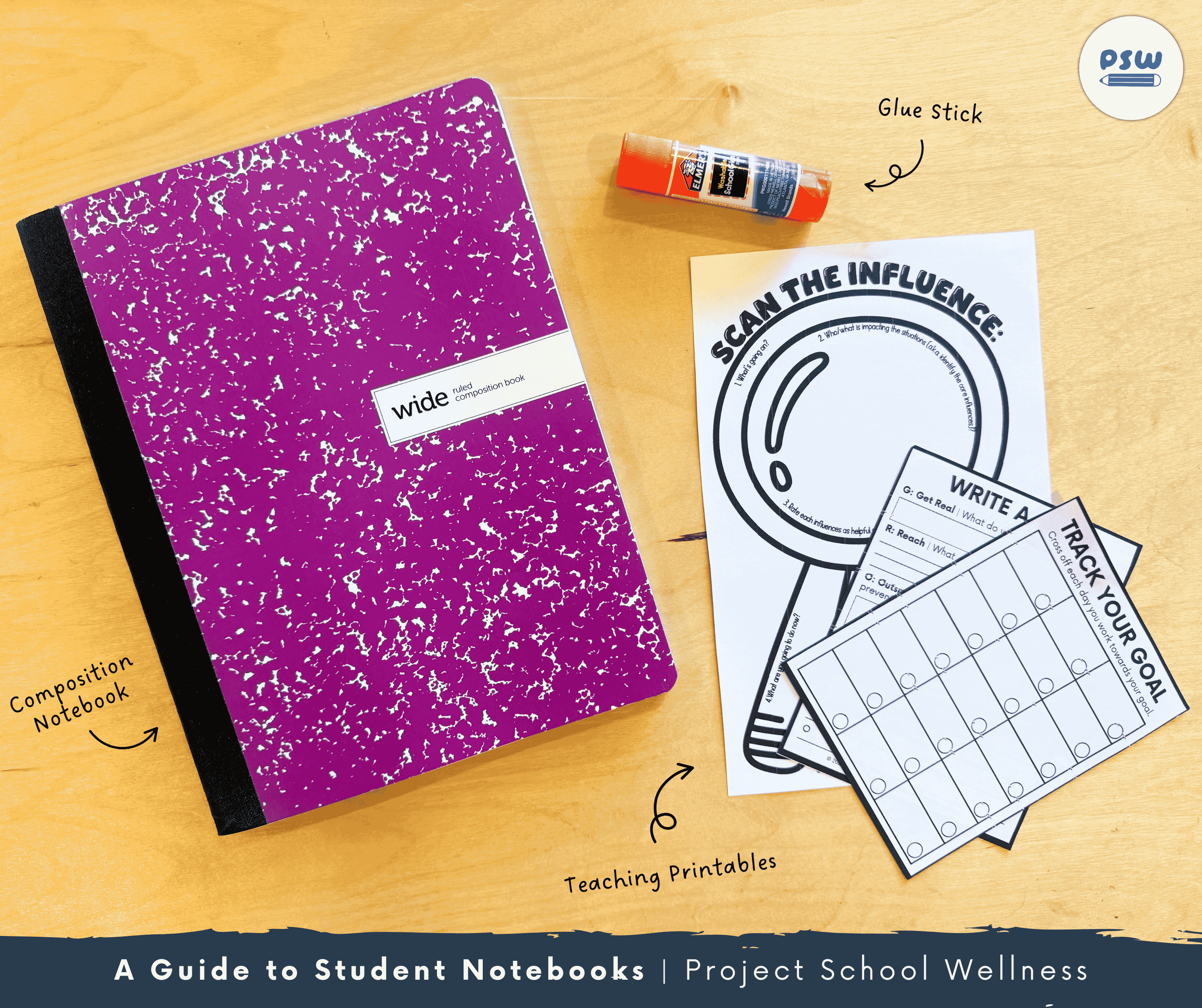
One composition notebook per student (really, any notebook would work)
Teaching printables - Sometimes they are learning activities, while other times they are learning graphics (content for students to reference).
Glue sticks (or tape or a stapler)
That’s it! The notebook is the “filing cabinet,” and everything students create lives there.
How to Use Student Notebooks Throughout the School Year
Here’s a quick breakdown of how students have been using their notebooks in health class this school year:
One Notebook for Everything - Each student has their own notebook that they use all year long. This notebook becomes their personal health resource and portfolio. Students know exactly where their work goes, and nothing gets lost.
Use Purposeful Learning Activities - Each class, I provide students with printed materials to work on during class. These are usually quarter-or half-sheet activities designed for very intentional tasks, such as:
Skill practice (i.e. a goal-setting tracker or influence report cards)
Glue Completed Work Into the Notebook - Once students complete an activity, they glue it directly into their notebooks. This keeps everything organized in sequence and helps track learning and growth over time.
Add Information Pages for References - In addition to activities, I will print off graphics with more traditional learning content. This may be an overview of the BEST Model and the health skills, a flow chart of the different types of advocacy, or an outline of skill cue steps. Students also glue these into their notebooks so they can reference them later.
Let the Notebook Become a Growing Textbook:
Over time, the notebook becomes:A portfolio of student work
A personalized health textbook
A record of skill practice, reflection, and growth
Students can flip back, make thoughtful connections, and see their progress throughout the course!

Why the Notebook System Works
This system works because it is intentional (it’s meaningful) and repetitive (there’s routine).
Students know their work matters because it is stored, revisited, and built upon. Teachers benefit from a streamlined way to manage student work and assess learning without juggling multiple systems.
Most importantly, student notebooks create a clear structure where learning artifacts are valued, organized, and connected. When everything has a purpose and a place, both teaching and learning become more effective.
Overall, this system has made me a very happy teacher! I’m excited to see how it continues to evolve:)
